Prella Guide
Esthetician Starter Kit: Everything You Need to Open, Nothing You Don't
Here's what your cosmetology program didn't teach you: the industry has a financial interest in you buying more than you need before you open. Equipment suppliers, distributors, and brand educators all make money when a new esthetician walks in the door convinced they need a $3,000 microdermabrasion machine, a full Dermalogica backbar, and a triple-function galvanic unit before they've seen their first paying client.
You don't need any of that. What you need is a carefully curated starter kit that lets you deliver an excellent facial, a brow wax, and a chemical peel — and nothing else — until you have the client volume to justify more.
Here's how to think about what actually goes in the kit.
The three-tier framework
Not everything you'll eventually own has the same urgency. Split your purchases into three tiers based on when you actually need them:
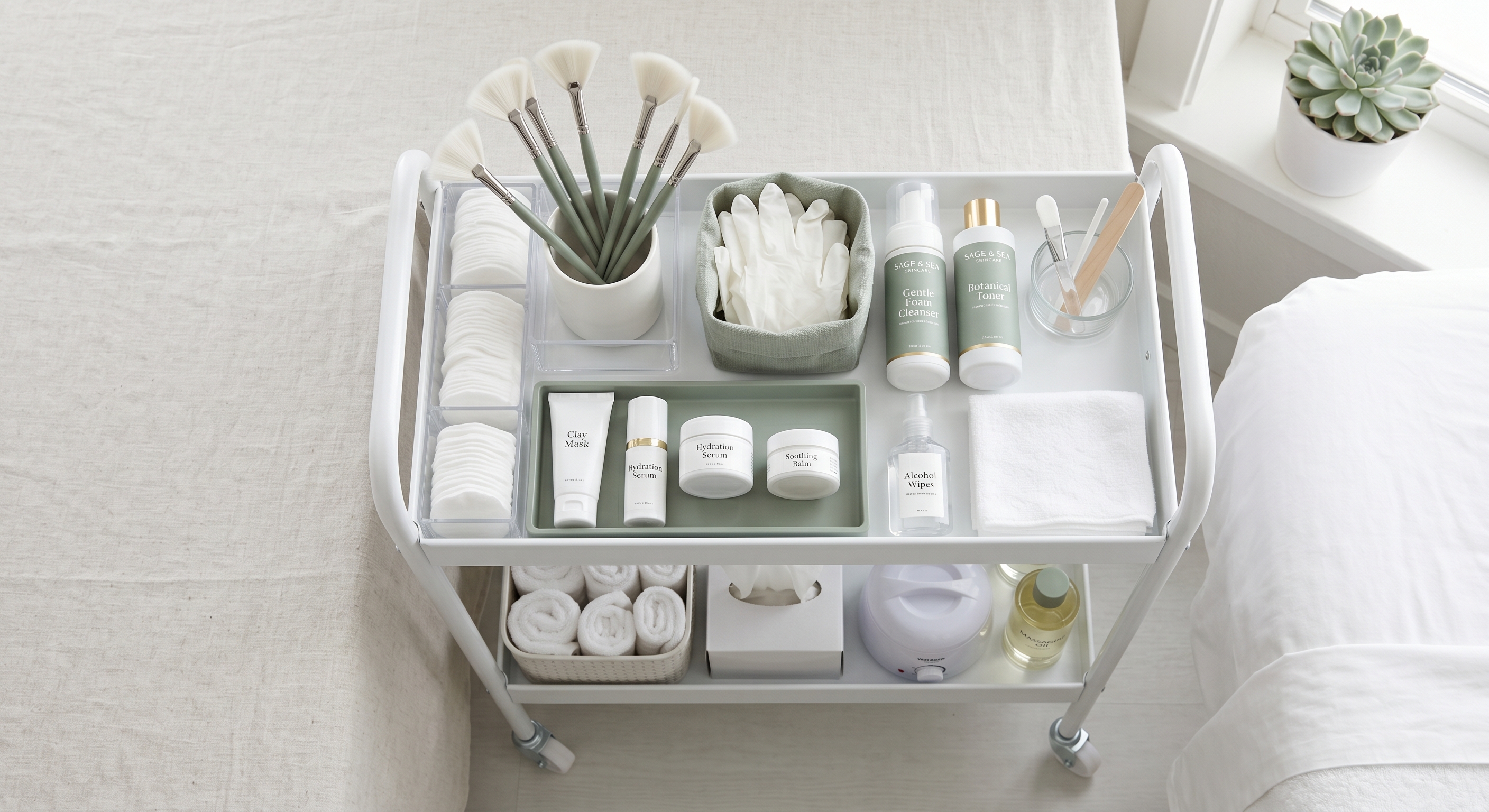
Tier 1 — Open with this. Everything you need to deliver your first service on day one. No compromises — if it's in Tier 1, you can't do the work without it. For a facial-based practice, this means: a treatment table, a steamer with magnifying lamp, a rolling stool, basic linens and disposables, and a skincare backbar.
Tier 2 — Add in month one. Items that improve the experience but aren't required for your core service. Hot towel cabinet, bolster pillow, a diffuser, a second set of linens, a UV sterilizer. Your clients won't miss these on day one. You'll want them by week four.
Tier 3 — Earn your way into these. The premium upgrades — a microcurrent device, an electric treatment table, LED panel, ring light for content. These cost real money and they only make sense once you have consistent bookings. Buying them on day one means they sit unused while you're still building your client base.
This framework saves most new estheticians $800–1,200 in unnecessary early purchases.
What Tier 1 actually costs
Here are the real numbers for a facial-focused solo practice. These are 2025–2026 Amazon pricing for quality equipment, not the cheapest option and not professional supplier premium:
That's less than a month's rent at most suite locations. If you're starting at home, your overhead before Tier 1 is $0 — so you could be operational for under $500.
The skincare backbar number assumes you're building your own from professional-grade single products rather than buying a full branded line. You can absolutely use Dermalogica's backbar program once you're established — but in the first 90 days, a practical backbar built from quality products at retail or distributor pricing serves clients just as well while you're finding your feet.
Studio Starter
Skip the research.
A menu priced for your city, a shopping list built around what you already have, and your first three months projected. In three minutes.
Build my plan →Waxing adds one more tier
If you're offering facial waxing (lip, brow, chin), add to Tier 1:
| Item | Cost |
|---|---|
| Double wax warmer | $40 |
| Hard wax beans (1 lb) | $15 |
| Pre-wax cleansing oil | $12 |
| Post-wax soothing oil | $14 |
| Wax applicator sticks (300-pack) | $10 |
| Waxing add-on total | $91 |
Full waxing-included Tier 1: ~$573.
Hard wax for face. Always. Soft wax pulls harder, increases the risk of lifting sensitive facial skin, and requires wax strips that add waste and cost. Every esthetician who's been doing facial waxing for more than two years has switched to hard wax. Don't start with soft.
The skincare line decision
New estheticians are aggressively courted by skincare brands during and after school, often with "free" education tied to committing to purchase minimums. Here's the honest read:
Three lines worth knowing at the professional starter level:
Dermalogica. High brand recognition with clients, good education program, strong retail sales potential. Backbar minimums are manageable. The price per treatment is higher, which means your COGS are higher, which means you need to price higher to maintain margin. Worth it once you have consistent clients.
Skin Script. Exceptional for hyperpigmentation and melanin-rich skin tones, relatively under-known with clients, no forced minimums. Great choice if your market or practice focus skews toward correction work.
Circadia. Clinical-grade formulations, lower brand awareness than Dermalogica but growing. Good middle ground on price-to-performance.
You don't need all three. Pick one. Use it until you know it well enough to explain every product to a client without hesitating.
Prella's Studio Starter tool generates a personalized product list based on the services you select — and it factors in your city's cost-of-living index so the numbers reflect your actual market, not a national average.
Chemical peel supplies: buy only what you'll use in month one
If you're adding chemical peels to your menu, the temptation is to stock a full range — TCA, Jessner's, glycolic at multiple percentages, lactic at multiple percentages. Don't.
Start with:
- Mandelic acid 25% (safest across all skin tones, forgiving on sensitive skin): $18
- Post-peel neutralizer: $10 — this is non-negotiable, always have it
Add lactic acid 40% once you've done 15–20 peel treatments and you know how your clients' skin responds. Add stronger options only after you have a track record and confidence in your contraindication screening.
The photo upload workflow that changes your intake process
One thing your starter kit can include that costs nothing: a systematic intake process with before-and-after photos. Clients who can see their skin improving over time rebook at a higher rate than clients who rely on memory. A before photo taken at intake and an after photo taken at checkout is the simplest retention tool in skincare.
Prella's photo recognition feature lets you photograph a client's skin and get an AI-assisted product and service recommendation — connecting your intake photos to your starter kit in one step.
What you should not buy before opening
A short list of common premature purchases:
- Microdermabrasion machine. Expensive, requires additional training, competes with chemical peels you already offer. Year two at the earliest.
- Oxygen infusion system. Same note. Clients don't know they want this yet; build demand with your core menu first.
- A full branded uniform set. One comfortable, clean, dark-colored outfit gets you through the first 90 days. Buy the matching set when you have a visual brand identity worth building on.
- Business cards, brochures, and printed menus. Your booking software is your menu. Your Instagram is your brochure. Physical collateral in year one goes in a drawer.
- Multiple skincare lines. Pick one and learn it. See above.
The pattern is the same across all of these: they feel like seriousness and professionalism, but they're spending money to perform readiness instead of actually opening.
The real timeline: open in under three weeks
Here's what's achievable with a clean starter kit and a home or suite-rental setup:
- Week 1: Order all Tier 1 equipment (Amazon Prime, most items arrive in 2 days), confirm your location, complete insurance registration.
- Week 2: Set up your space, do 3–4 practice facials on friends and family, take before/after photos, work out your treatment flow.
- Week 3: Launch. Text 10 people. Take your first paid bookings.
The esthetician starter kit your cosmetology program didn't teach you about isn't a room full of equipment. It's a $500 investment, a two-week setup, and the confidence to take your first booking before you feel completely ready.
Use Prella to build your custom starter list — it takes five minutes and gives you a tiered, priced, market-adjusted shopping list based on your specific services and location.
Links may earn us a small commission at no cost to you.
Your studio, planned in three minutes.
Free, no account, nothing to cancel. Your menu priced for your city, and exactly what to buy next.
Build my plan →