Prella Guide
Esthetician Suite Rental vs. Booth Rental vs. Home Studio: A Real Comparison
Here's what your cosmetology program didn't teach you: the decision about where to work is a financial and lifestyle decision as much as a professional one, and the industry has a strong incentive to push you toward the priciest option. Suite rental buildings have marketing budgets. Booth rental salons have recruiting efforts. Nobody is marketing the home studio option to new graduates.
Here's an unbiased look at all three.
What each option actually is
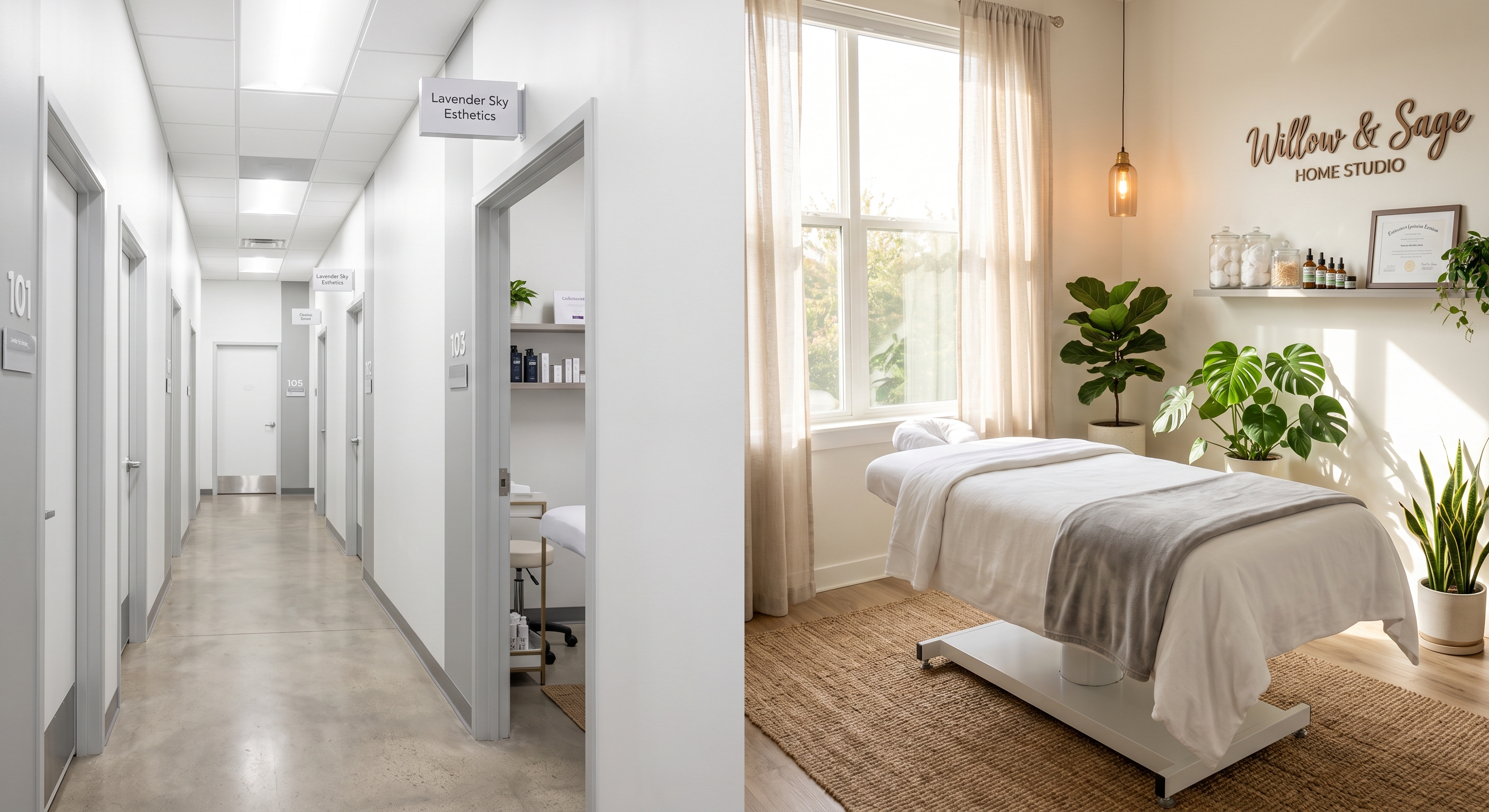
Suite rental means you lease a private room — typically 100–120 square feet — inside a building designed for independent beauty professionals. Phenix Salon Suites, Sola Salons, and IMAGE Studios are the three major chains; there are also independent operators in most mid-size markets. You sign a lease (usually week-to-week or month-to-month to start), pay flat weekly rent, and operate completely independently. You set your prices, your hours, and your brand. The building provides utilities, Wi-Fi, shared laundry, and sometimes a shared reception area.
Booth rental inside a salon means you rent a station or a dedicated area within an existing full-service salon. You're independent — you pay rent, not commission — but you're sharing a public-facing space with other stylists, nail techs, or estheticians who may be employees or booth renters. Less privacy than a suite, but often cheaper, and the host salon's existing foot traffic can help you get initial bookings.
Home studio means you operate your practice in a dedicated room in your residence. Legal in most states with a home occupation permit. Your overhead above equipment is negligible — the space is already paid for as part of your housing cost. Most of the cost difference between a home studio and a suite goes directly to your net income.
The cost comparison
These numbers are representative of a mid-cost-of-living market (Columbus, Kansas City, Charlotte, Phoenix). Adjust up 30–45% for coastal metros, down 10–15% for smaller cities.
Suite rental:
- Weekly rent: $250–400/week, all-inclusive
- Annual overhead: $13,000–20,800
- Typical included: utilities, Wi-Fi, laundry access, basic furniture (chair, mirror)
- Equipment you bring: treatment table, steamer, rolling stool, rolling cart, your product backbar
- Startup cost (equipment only): $450–600 — see the esthetician starter kit guide for the exact breakdown
Booth rental:
- Weekly rent: $150–275/week, variable on what's included
- Annual overhead: $7,800–14,300
- Typical included: utilities, shared laundry, sometimes a shared reception/booking
- What you control: varies. Confirm before signing whether you set your own prices and hours completely.
Home studio:
- Weekly overhead: near zero (incremental housing cost only)
- Annual overhead: $0–2,400 (permits $25–100/year, incremental utilities)
- Equipment identical to suite rental: $450–600 one-time
- Additional setup: vinyl plank flooring if carpet exists ($200–400), ventilation fan if needed ($50–150)
- Legal compliance: home occupation permit + state cosmetology board home facility approval
Studio Starter
Skip the research.
A menu priced for your city, a shopping list built around what you already have, and your first three months projected. In three minutes.
Build my plan →The professional experience comparison
Privacy: Suite rental offers the cleanest client experience. Private room, professional building, no personal context. Home studio can match it with deliberate setup and strong household rules during working hours. Booth rental offers the least privacy — shared space, ambient noise, potentially other professionals' clients visible.
Brand control: Suite rental and home studio are both fully under your control — you brand the space as you want. Booth rental may have host salon restrictions on signage, decor, or client communication.
Professionalism signal to new clients: Suite buildings project an immediate credential. Phenix, Sola, and IMAGE all have professional lobbies, parking, and a commercial address that signals established business to a client who hasn't met you yet. Home studios require more trust-building for first-time clients from cold referrals or Google. Clients who know you personally make the home transition easily.
Flexibility: Suite rental leases are often week-to-week or 30-day notice. Home studios have no lease obligations at all. Booth rental varies — some are month-to-month, some require 60–90 day notice.
The revenue comparison at different client volumes
Assumptions: $130 average ticket, 18 clients/week, mid-market.
| Suite | Booth | Home Studio | |
|---|---|---|---|
| Monthly gross | $9,360 | $9,360 | $9,360 |
| Monthly overhead (rent/space) | $1,300 | $850 | $100 |
| Product + insurance + software | $600 | $600 | $600 |
| Net before taxes | $7,460 | $7,910 | $8,660 |
Over a year, the home studio generates $14,400 more net income than the suite option, and $9,000 more than booth rental. That's significant at early-career earnings levels.
The suite earns that back in reduced friction — no zoning compliance, no household management, immediate professional credibility — which has real value. Whether that value is worth $14,400/year to you is a personal calculation.
The hidden variable: client acquisition
This is the factor most comparison guides skip.
Suite buildings and established salons have walk-in traffic, building directories, and co-marketing from neighboring professionals. A new esthetician in a Phenix building can get incidental bookings from people who walked into the building for another reason.
Home studios have zero walk-in traffic. Every client is intentional — they booked you because of a referral, a review, or something they saw on social media.
For an esthetician with a strong personal network and good social media presence, the home studio disadvantage on walk-in traffic is irrelevant. For someone starting fresh in a new city without an existing referral base, the suite building's commercial presence has real value.
The decision framework
Choose suite rental if:
- You're new to an area and don't have a personal referral network
- You want the simplest possible setup with no legal complexity
- Your housing situation doesn't accommodate a dedicated treatment room
- You want to be fully operational in under a week
Choose booth rental if:
- You want to reduce overhead while building your client base
- The host salon's aesthetic and clientele are compatible with yours
- You've confirmed full pricing and scheduling independence in writing
Choose home studio if:
- You have a dedicated, separate-entry room available
- Your market is one where clients are comfortable coming to a home-based practitioner
- You have a referral network or social presence to generate bookings
- You want maximum profitability from day one
All three options can support a financially successful solo esthetician practice. The startup cost difference is meaningful — see the home studio setup guide for what the home setup actually requires — but the operational difference is mostly in your overhead and profitability math.
The comparison guides you'll find from suite building companies all conclude that suites are the obvious choice. Surprise. The honest answer is that the right choice depends on your network, your market, and your household situation.
Your cosmetology program skipped this entirely. Now you have the framework.
Use Prella to build your equipment list and price your services — the numbers work across all three setups, and it'll calculate your market-adjusted prices so you know your margin regardless of where you're working.
Links may earn us a small commission at no cost to you.
Your studio, planned in three minutes.
Free, no account, nothing to cancel. Your menu priced for your city, and exactly what to buy next.
Build my plan →