Prella Guide
Free. 3 minutes. No signup until the end. Your menu, shopping list, and earning projection — priced for your city.
How to Become a Lash Tech
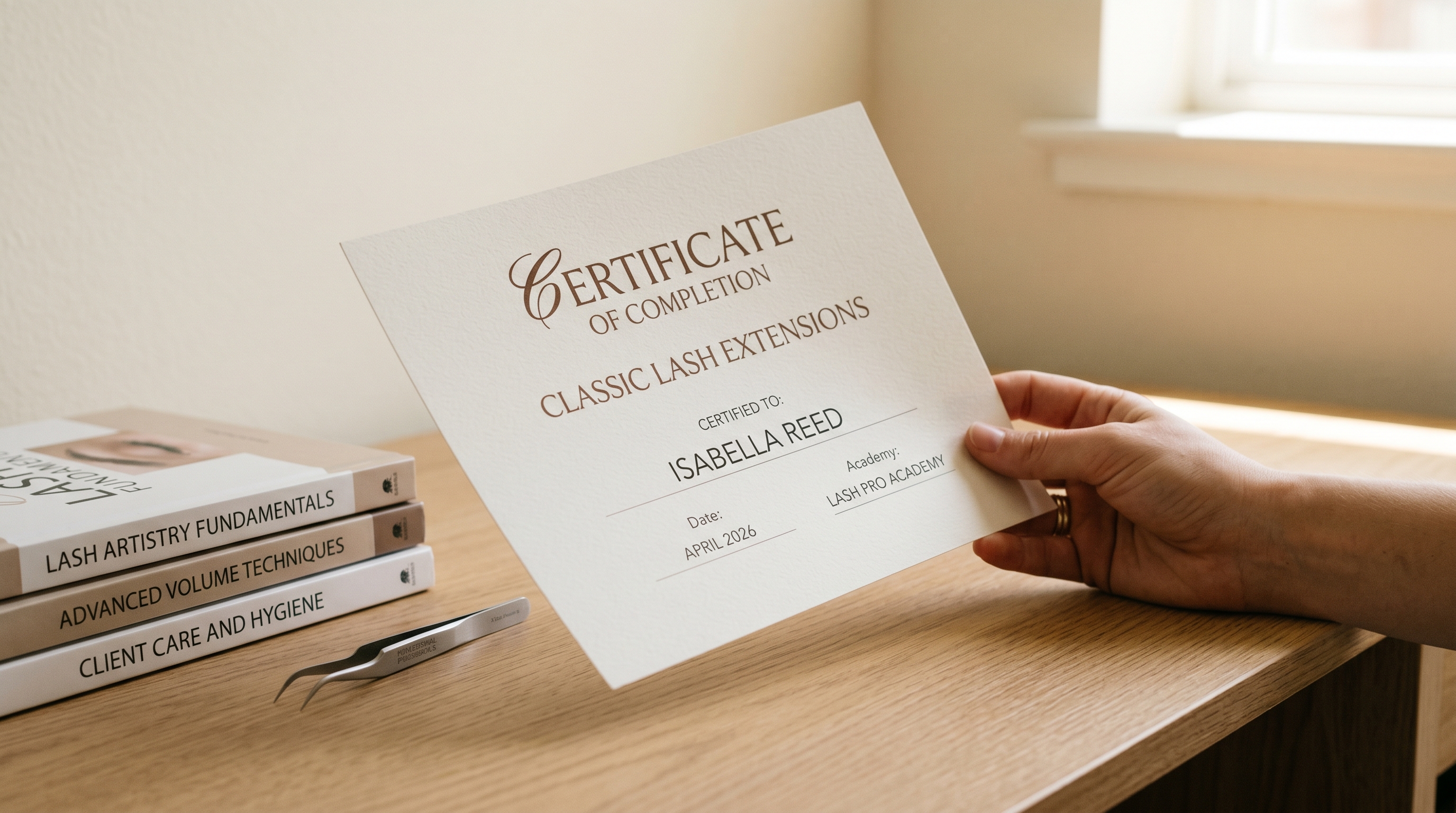
Most people can go from "I want to do this" to seeing their first paying client in six to ten weeks. The steps are straightforward: confirm what your state requires, finish a training course, pass certification, get insurance, set up a space, and start booking. The timeline varies more by state licensing than by your pace.
Here's the whole path.
What license do you actually need
Lash licensing is one of the most state-specific parts of the industry, so the first step is finding out what your state board requires. Three broad categories:
States that require a cosmetology or esthetics license. Most of the US falls here. You'll need 300–1,500 hours of coursework through a state-approved program depending on the license type. Esthetics is the shorter path and the more common one for lash-only artists.
States that accept a lash-specific certification. A growing number of states — including Texas, North Carolina, and Pennsylvania — allow a short-form lash certification (40–120 hours) in place of a full cosmetology or esthetics license. This is the fastest legal path when it's available.
States with no license requirement. Connecticut and Florida are the most notable. You still need a local business license and liability insurance, but you don't need a state credential. Many lash artists in these states still pursue a certification because it signals quality to clients.
Before you spend money on equipment or training, check with your state board directly. Requirements shift year to year and your salon or suite landlord will often want to see your credential before handing over a key.
Training options
Four broad paths, ordered from fastest and cheapest to longest:
Online lash courses — $200–800. Work-at-your-own-pace video training, often including a kit. Good for learning the theory and seeing the steps. Not enough on its own — you'll still need hands-on practice on a live model to pass any real certification.
In-person lash certification — $800–2,500. Two- to five-day intensive with live model practice, instructor feedback, and a take-home kit. This is the standard path in states that accept lash-specific certification. Look for a course that includes at least one live model appointment you complete start-to-finish.
Combined online + in-person — $600–1,500. Online theory plus a one- or two-day hands-on session. The best balance of cost and quality for most new lash artists.
Cosmetology or esthetics school — $5,000–20,000. Required in states that don't accept lash-specific certification. Takes 6–12 months. Covers far more than lashes, which is an advantage if you want to add services later and a disadvantage if you only want to do lashes.
Studio Starter
Skip the research.
A menu priced for your city, a starter kit built around what you already have, and your first three months projected. In three minutes.
Build my lash plan →What to look for in a training program
Not all courses are worth the money. Before you enroll, check:
- Live model hours. You should complete at least one full set on a real person before your certificate ships.
- Retention guarantee. A serious program covers retention troubleshooting — the single skill that separates sustainable lash artists from ones who quit after six months.
- Board approval. If your state requires approval, the program will list its approval numbers on the site. If it doesn't, keep looking.
- Kit quality. Some programs include a take-home kit; the kit quality varies wildly. Check whether the adhesive, trays, and tweezers are sold separately under recognizable professional brands.
After certification: how to actually start working
Certification is the start, not the finish. Here's what happens next:
Business registration. Register a sole proprietorship or LLC with your state ($50–300 depending on state and structure). You'll need this for a business bank account, insurance, and any suite rental agreement.
Liability insurance. Non-negotiable. Plans start around $200–400/year through Associated Skin Care Professionals (ASCP) or the Professional Beauty Association (PBA). Both include general and professional liability, which covers you if a client has a reaction to adhesive or is injured during a service.
Workspace. Home studio, suite, booth, or mobile. See the how to start a lash business guide for the full breakdown.
Equipment. Bed, magnifying lamp, stool, tweezers, adhesive, primer, trays, under-eye pads, sterilization supplies. Full starter kit runs $450–750. Build your personalized list →
Your first ten clients. Individual texts to people you know, a small model-rate discount in exchange for reviews and photos, an Instagram portfolio, and a Google Business listing. Expect 5–7 of your first 10 outreach texts to book.
Equipment you need on day one
Everything in the tier-1 starter kit — bed, magnifying lamp, stool, isolation tweezer (straight), isolation tweezer (curved), pickup tweezer, professional adhesive matched to your speed, primer, lash shampoo, gel remover, a C-curl tray, a D-curl tray, under-eye gel pads, micro brushes, medical tape, face cradle covers, fitted sheets, nitrile gloves, and a disinfecting solution. That's about $500 in materials, less if your suite provides the bed and lamp.
You do not need: a nano mister (nice but skippable on day one), a practice mannequin (only if you want to drill new techniques), or an air purifier (add in month two). You especially do not need pre-made volume fans on day one — hand-fan practice is what makes you a better lash artist.
A realistic timeline
| Phase | Weeks | What happens |
|---|---|---|
| Research | 1 | Check your state board, pick a training path, budget your startup |
| Training | 2–6 | Coursework and live-model practice |
| Certification | 1 | Exam, photo submission, certificate issued |
| Setup | 1–2 | Business registration, insurance, equipment order, space setup |
| Soft launch | 1 | 3–5 model-rate appointments, iron out your flow |
| Paid bookings | Ongoing | Text your first ten, post before-and-afters, collect reviews |
Most new lash artists go from "first training class" to "first paying client" in 6–10 weeks. Some do it faster. The limit is usually the state board's response time on your certification paperwork, not your own pace.
Your next step
If you're in a state that allows lash-specific certification, you can be taking paid bookings in under two months.
Build your personalized lash business plan →
Three minutes, no credit card. Your menu priced for your city, a starter kit built around what you already own, and a projection of your first three months at 3 clients a week.
Related: How to start a lash business · Lash training guide · How much do lash techs make
Links may earn us a small commission at no cost to you.
Your lash business, planned in three minutes.
Free, no account, nothing to cancel. Your menu priced for your city, and exactly what to buy next.
Build my lash plan →