Prella Guide
Free. 3 minutes. No signup until the end. Your menu, shopping list, and earning projection — priced for your city.
How to Start an Esthetician Business: The First 90 Days
Here's what your cosmetology program didn't teach you: starting a business and being ready to start a business are two completely different things. Most estheticians spend 6–18 months in "I'm almost ready" mode — building a website, perfecting their logo, researching equipment options, taking one more continuing education class — while their license sits unused and the clients they could be serving go somewhere else.
The first 90 days aren't about being perfect. They're about being open and adjusting from there.
The decision you have to make first: where you'll work
Your location choice shapes every other decision, so make it before you spend a dollar on anything else.
You have three realistic options as a solo esthetician just starting out:
Suite rental. You rent a private room inside a salon suite building — Phenix Salon Suites, Sola Salons, or IMAGE Studios are the three largest chains. All-inclusive pricing (utilities, Wi-Fi, basic furniture, sometimes towel service) typically runs $200–450/week depending on your market. You're independent — you set your own hours, prices, and brand. No booth rental commission. Clients come to you.
Booth rental inside a salon. You rent a station inside an existing salon, usually by the week. Cheaper than suite rental in most markets, but you're sharing a space and you may have less control over your environment, hours, and aesthetic. Works well if the salon has foot traffic you can tap while building your own client base.
Home studio. Legal in most states with a home occupation permit and a dedicated, separately accessible treatment room. Your overhead is essentially zero beyond supplies and a portion of utilities. The tradeoff is zoning compliance, professional presentation, and the comfort level of new clients coming to a home address. More on this in the home studio setup guide.
For most new solo estheticians, suite rental is the cleaner start. You're immediately professional, zoning isn't your problem, and the all-inclusive format makes your monthly overhead predictable.
Month 1: setup and your first clients
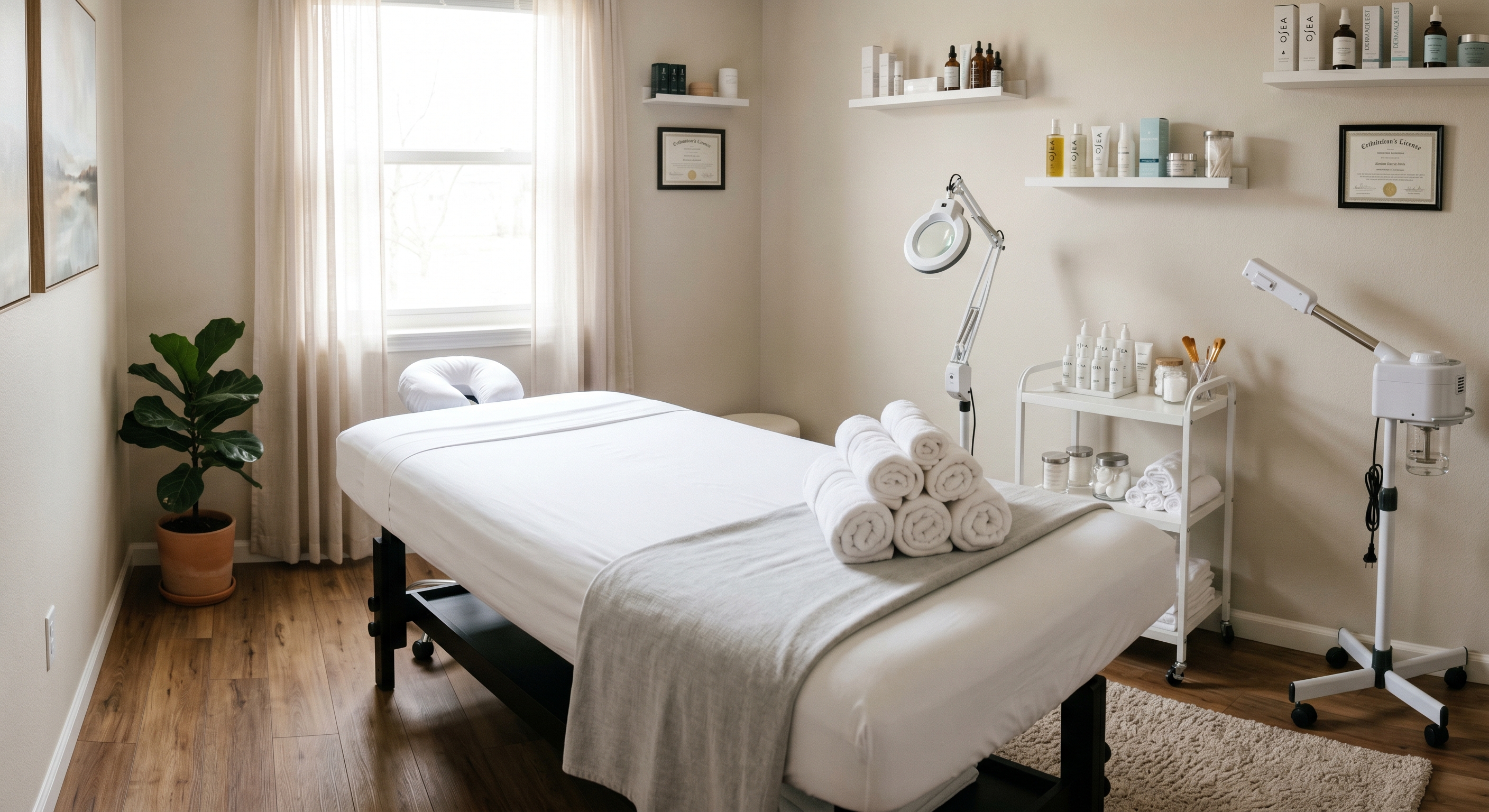
Week one is logistics. Order your Tier 1 equipment — refer to the esthetician starter kit guide for the exact list and links. Most equipment arrives in two days via Amazon Prime. Set up your treatment room. Get your professional liability insurance (starting at $35/month for solo estheticians). Confirm your state license is current and posted.
Week two is practice. Do three to five complimentary or deeply discounted facials on people you know. Not because you need the practice — you have the training — but because you need to run your intake, treatment, and checkout flow several times before money is on the line. Work out where you'll store things during a treatment. Practice your consultation. Find out how long your service actually takes when you're in your own space.
Week three: take money. Text ten people individually. Not a group message, not an Instagram post — individual texts to people you know who might want a facial or who know people who do. "I just opened my own studio and I'm taking my first paid bookings. I'd love to give you a facial." Include your pricing. Offer a soft-launch rate ($15–20 off) in exchange for a review. Five of the ten will book. Possibly seven.
That's 5–7 clients in week three. That's a real start.
Studio Starter
Skip the research.
A menu priced for your city, a shopping list built around what you already have, and your first three months projected. In three minutes.
Build my plan →Pricing: set it correctly before you open, not after
The single most common mistake new estheticians make isn't their technique or their equipment. It's pricing too low and then being unable to raise prices without feeling awkward.
Set your prices at market rate before you open. Not "what the salon down the street charges" — what the market in your specific area supports for a solo esthetician in a professional setting. If you don't know that number, Prella's Studio Starter tool calculates market-adjusted pricing by city and service type, factoring in local cost-of-living data.
The standard for a 60-minute signature facial in a mid-cost-of-living market is $125–145. In a high-cost market (coastal cities, affluent suburbs), it's $155–195. In a lower-cost market, $95–115.
Set your price at that market rate. The soft-launch discount for your first 10 clients is a temporary promotion, not your price. After the promotion ends, your price is your price.
Month 2: build the habit of rebooking
By week five or six, you'll have clients who've seen you once. The most important thing you can do in month two is convert first-time clients into returning clients.
The rebook conversation happens at checkout, not at the door. While your client is still in the chair — or standing at your cart, looking at their skin — is the moment. "Your skin responded really well to the peel today. For the results we're working toward, I'd love to see you again in four weeks. I have Tuesday the 14th or Thursday the 16th — which works better?"
Two specific options. Not "let me know when you'd like to come back." Estheticians who present two specific options at checkout rebook 60–70% of first-time clients. Estheticians who leave it open-ended rebook 20–30%.
When a client hasn't come back in six weeks, send a personal text. Not an automated email — a real text. "Hey, just thinking about your skin — the last treatment we did worked really well for your dehydration. Wanted to check in and see if you'd like to get back on the books." Short. Personal. Direct.
Month 3: fill the gaps and raise the average ticket
Month three is about increasing revenue per client, not just finding more clients.
Add one or two add-ons to your menu and start recommending them actively. Dermaplaning ($35 added to a signature facial), a LED light boost ($25), or an eye rescue treatment ($20) each adds meaningful revenue per appointment without extending the service more than 15–20 minutes. If 40% of your clients take even one add-on, your average ticket climbs from $130 to $145–155.
This is also when you start building retail. Not a full retail wall — one or two products you genuinely recommend that complement the treatment you just did. An SPF moisturizer clients can use at home. A vitamin C serum for morning use after a brightening treatment. Retail margins run 40–50% on professional skincare, and a $48 retail moisturizer at 40% margin adds $19 to your gross on a transaction you were already processing.
At 18 clients per week with a $145 average ticket including add-ons, you're looking at $2,610/week — roughly $10,400/month gross. After suite rental, products, insurance, and software, a solo esthetician in this position is netting $8,000–9,000/month. That's what full books at correct pricing looks like.
The 90-day summary
The pattern for the first 90 days is simple, even if it takes work to execute:
- Choose your location and sign your rental agreement.
- Order Tier 1 equipment, get insurance, confirm your license.
- Practice on five people before your first paid booking.
- Price at market rate from day one.
- Text ten people in week three and take your first bookings.
- Rebook clients at checkout with two specific options.
- Add one or two add-ons in month two and recommend them actively.
- Start retail in month three, one or two products maximum.
Your cosmetology program told you that you needed more preparation. You probably needed less. The fastest path to a full book is being open, charging correctly, and showing up for the clients who trust you enough to come.
Prella's Studio Starter tool builds your equipment list, calculates your startup cost, and shows you market-adjusted pricing for your specific city — all in about five minutes. It's the pre-opening math your program skipped.
Links may earn us a small commission at no cost to you.
Your studio, planned in three minutes.
Free, no account, nothing to cancel. Your menu priced for your city, and exactly what to buy next.
Build my plan →